
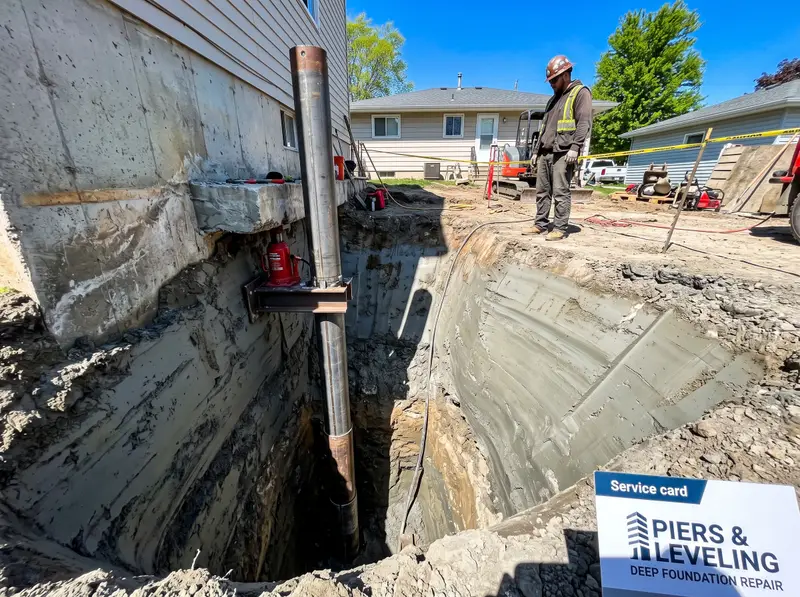
Foundation piers in St. Peters, where mapped surface clay runs as high as 48 percent: leveling a house means installing support below the soil that is moving, then raising the structure back toward its original elevation as far as it will safely go.
Pushed or turned — which pier suits this house?
Both reach load-bearing ground below the soil that let the footing drop. What differs is how they get there and what the house has to give up while they do. Push piers are driven beside the footing with a hydraulic ram, using the weight of the house as the reaction, which is why they are the common answer under a full-weight house. Helical piers are turned in with a torque motor and suit light structures, additions and porches where there is not enough weight overhead to push against. Neither one fixes a basement wall that has bowed or leaned. A pier carries a footing, and a wall pushed in from the side is held from the side, which is a separate job on a separate page. The question to ask any firm quoting a pier is why that one for this house. If the answer is about the house — its weight, its access, the depth to load-bearing ground — it is a real answer. If it is about the equipment they own, it is not.
That choice has a page of its own: Push Piers vs Helical Piers in St. Peters, MO.
What decides pier depth under a St. Peters house
The shallowest mapped water table under St. Peters reaches the surface. Up to 48% of the soil is clay. Both numbers land in one place on a quote: depth. A pier has to reach past the layer that moves and bear on something that does not, and neither depth is fixed across a street. That is why depth is measured during installation rather than promised in advance.
What each foundation repair covers, and what it costs to get wrong
Push Pier Installation
Steel pipe sections driven down beside the footing with a hydraulic ram, using the weight of the house as the reaction, until they reach load-bearing ground. It is the common answer under a footing that has settled on a full-weight house, because the house itself supplies the force that drives each pier down.
What moves the price. Pier count and depth to load-bearing ground, which varies street to street. Each pier needs a hole dug beside the footing, so a walkway, a porch or a finished basement wall in the way adds to it.
When Push Pier Installation is the wrong answer. If the wall above the footing has bowed or leaned while the footing stayed put, piers under it fix the wrong part. A wall that moved inward is held from the side, and the survey is what separates the two.
Helical Pier Installation
Steel shafts with helical plates turned into the ground with a torque motor, with installation torque read as a proxy for capacity. It suits light structures, additions and porches, and sites where there is not enough building weight overhead to press a pile.
What moves the price. Shaft count, torque reached and headroom. Confined access under a porch or inside a crawl space slows everything. Deeper competent ground means more extensions per shaft.
When Helical Pier Installation is the wrong answer. Under a full-weight house with room to dig beside the footing, a push pier is usually the cheaper route to the same support. Helicals earn their place where the load is light or the reaction is missing.
Get a foundation repair estimate in St. Peters
None of this can be priced from a description. Three things decide it. How many support points the house needs. How deep each one has to reach before it finds ground that does not move. How much of the work is indoors. All three are facts about an address, and none of them show up in a photograph. Send the address and what you are seeing. Someone who does this work in St. Peters takes it from there. If it turns out to be a smaller job than the one you came here for, that is worth hearing before anyone starts.
St. Peters Foundation Repair Co services.
Read what a St. Peters foundation repair job costs before calling anyone, and check the St. Peters Foundation Repair Co service area to see whether your street is covered.
Back to St. Peters Foundation Repair Co.
The ground under St. Peters
Pier depth is found during the work and not promised in the quote
The shallowest mapped water table reaches the surface
A pier has to bear on ground that does not move with the season. Where the seasonal high water table comes this close to the surface, the soil above it is saturated for part of the year and is not that ground. A bored hole in wet soil can also slough or fill before concrete reaches it. Ask how depth to refusal is recorded at each pier, and ask what happens to the price when one goes deeper than the quote assumed. This is the shallowest value among the largest soils mapped here, not a typical one.
USDA NRCS Soil Survey Geographic Database (SSURGO), via Soil Data Access
Pier depth starts from a named soil, not from a guess
The largest soil unit mapped in St. Peters is Harvester-Urban land complex, 2 to 9 percent slopes
Soil surveys map ground in named units, and the name carries the expected profile — what the ground is made of at depth and where firmer ground sits. Push piers, helical piers and drilled piers are all attempts to reach that ground by different routes. Ask which method is proposed, what depth it is expected to reach, and how that expectation was arrived at. A method chosen before the floor elevations were taken was chosen for the wrong reason.
USDA NRCS Soil Survey Geographic Database (SSURGO), via Soil Data Access
Questions people actually ask
Can a house be lifted all the way back to level?
Rarely, and attempting it can do more harm than the settlement did. Plumbing, brick and drywall have all set in the moved position, so the aim is usually to recover most of the movement and stabilize it.
How many piers does a house need?
It is set by where the movement is and what carries load above it, not by the size of the house. A survey showing the shape of the movement is what a pier count is built from.
How deep do piers go here?
Deep enough to bear on ground that will carry the house, which varies street to street. A push pier is driven until it takes the load it was set for and a helical until it reaches its torque, so depth is measured during installation rather than assumed beforehand.
Will the work damage the inside of the house?
Perimeter work happens outside. Interior piers mean opening and closing the floor at each location, which is why they cost more per pier and why a quote should say how many of each it includes.
Does lifting a house break the plumbing?
It can, because the pipes have settled with the slab. A post-lift plumbing test is worth asking about before the work rather than after, and any firm that has done this before will expect the question.
Ground that is saturated has nowhere to put the next storm, and water sitting against a wall keeps working on it.
What happens after you send an address
-
The address first, and only then who you are
The first screen asks for the property address and checks that a contractor covers it. Only if one does does it ask for a name, a phone number and an email — there is no point taking your details to tell you nobody serves your street.
-
Your details are not for sale
It goes to a foundation repair contractor working in St. Peters. The details are never sold, and never passed to a second firm.
-
No cost, and nothing attached
There is no fee for sending an address and no obligation that follows from it. Deciding the work is the wrong work is a perfectly good outcome.
-
Who does the work
An independent foundation repair contractor, not the publisher of this site. Who runs this site, and where every figure on it comes from, is set out on the about page.