
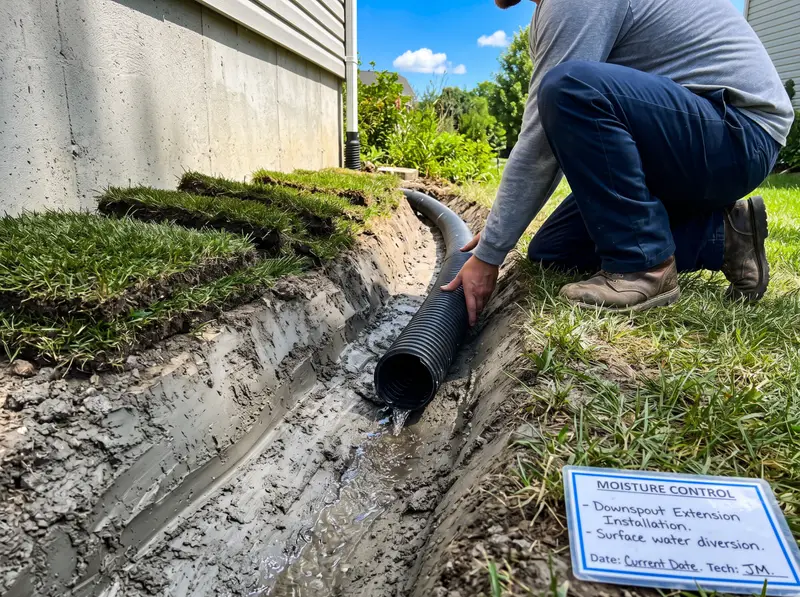
Wet soil presses harder on a basement wall than dry soil, and water standing against the wall finds any crack it has, so the work is getting surface water away from the house.
Where is the water arriving from, and where is it going?
This group is the cheapest place on this site to spend money, and the first. If water stands against the house after rain, the soil against the basement wall is wet more often than it needs to be, and the work is to get surface water away: grade first, then extend the downspouts, in that order. Extending a downspout onto ground that slopes back toward the house just delivers the water further out and lets it run straight back. If water is already coming in and the wall is straight, the job past these two is waterproofing, a different trade. If the wall has bowed or cracked through, it is the basement wall page, and these two are still worth doing first, because a braced wall with water standing against it carries a heavier load than it needs to.
Where water goes when it lands on a St. Peters lot
The dominant soil under St. Peters is hydrologic group C and is rated Moderately well drained. Group A soil takes water in quickly and group D barely takes it at all. Either way, water that reaches a foundation wall faster than the ground can carry it off stands against it, and a downspout emptied at the corner of the house is the most common way that happens. Grade and roof water are the cheapest things to fix.
What each foundation repair covers, and what it costs to get wrong
Surface Drainage Correction
Re-grading and shaping the ground within the first several feet of the structure so surface water leaves rather than stands. It is the first thing to correct, because water that stands against a foundation wall soaks the soil pressing on it and finds any crack the wall already has.
What moves the price. How much soil has to move and what is in the way. Beds, walkways, air conditioning pads and mature plantings all have to be worked around or lifted and reset.
When Surface Drainage Correction is the wrong answer. If the water is arriving from a neighboring lot or a street that drains toward you, regrading your own ground moves the problem a few feet. That is a larger conversation and sometimes a municipal one.
Gutter and Downspout Extension
Carrying roof water far enough from the structure that it does not soak the ground the foundation bears on, by extension or buried line. It is the cheapest intervention available on most lots and the one most often missing. A roof sheds a great deal of water into a very small area, right beside the wall.
What moves the price. Run length and whether the line is buried. Surface extensions are simple. A buried run needs a trench, a fall the whole way and somewhere legal to discharge.
When Gutter and Downspout Extension is the wrong answer. If the ground already slopes back toward the house, extending a downspout delivers the water further out and lets it run straight back. Grade first, then extend.
Get a foundation repair estimate in St. Peters
None of this can be priced from a description. Three things decide it. How many support points the house needs. How deep each one has to reach before it finds ground that does not move. How much of the work is indoors. All three are facts about an address, and none of them show up in a photograph. Send the address and what you are seeing. Someone who does this work in St. Peters takes it from there. If it turns out to be a smaller job than the one you came here for, that is worth hearing before anyone starts.
St. Peters Foundation Repair Co services.
Read what a St. Peters foundation repair job costs before calling anyone, and check the St. Peters Foundation Repair Co service area to see whether your street is covered.
Back to St. Peters Foundation Repair Co.
The ground under St. Peters
How much of this ground drains on its own decides where water beside a wall comes from
1 percent of the land mapped here is soil that drains freely
Hydrologic groups A and B are the soils that take water down readily, and this is their share of the mapped land area. Where that share is small, rain stays near the surface and along the walls. Where it is large, water that still collects beside a house is usually arriving from somewhere specific. Either way, ask for grade and downspout discharge to be looked at first, because they are the cheapest work available.
USDA NRCS Soil Survey Geographic Database (SSURGO), via Soil Data Access
The storm that soaks the ground beside a wall is a normal storm here
A ten-year storm drops 4.54 inches on St. Peters in a day
The National Weather Service publishes this depth for this location with a stated confidence range. A storm that size is not unusual, and the soil beside a foundation takes on as much of it as it can hold. Ask what a proposal does with roof water specifically, and how many feet from the wall it ends up.
NOAA Atlas 14 Volume 1 Version 5, Precipitation Frequency Data Server
The soil group says whether water beside a wall moves down or stays
The largest soil mapped in St. Peters is hydrologic group C
Hydrologic group ranks how readily a soil takes water down, from A, the fastest, to D, the slowest. On slow ground rain stays near the surface and along the walls; on fast ground water that collects beside a house is usually arriving from a downspout or a low spot. Ask what a proposal does with roof water, and how many feet from the wall it ends up.
USDA NRCS Soil Survey Geographic Database (SSURGO), via Soil Data Access
Questions people actually ask
How far from the house should a downspout discharge?
Further than most are. The aim is to get roof water past the soil the foundation bears on, which means at least 6 feet from the wall, and 10 is better. A splash block at the wall does not achieve it.
How far should the ground slope away from the house?
Enough that water runs away rather than standing. A common rule is about 6 inches of fall over the first 10 feet, and soil that has settled against the wall over the years usually needs building back up to get there.
Does a sump pump fix water against the outside of the wall?
No. A sump pump removes water that has already reached the drain under the floor. Water standing against the outside of the wall is a grading and downspout question, and fixing those first is what keeps a pump from running every storm.
Is water in the basement a foundation problem?
Not on its own. Water through a wall that is straight and sound is waterproofing, a different trade. It becomes a foundation question when the wall has bowed, leaned or cracked through, and a string line down the wall is where that measurement starts.
What should I fix first?
Grade, then gutters, then everything else. Those 2 are the cheapest interventions available and they address the mechanism directly, which is why anything else bought before them is bought in the wrong order.
Ground that is saturated has nowhere to put the next storm, and water sitting against a wall keeps working on it.
What happens after you send an address
-
The address first, and only then who you are
The first screen asks for the property address and checks that a contractor covers it. Only if one does does it ask for a name, a phone number and an email — there is no point taking your details to tell you nobody serves your street.
-
Your details are not for sale
It goes to a foundation repair contractor working in St. Peters. The details are never sold, and never passed to a second firm.
-
No cost, and nothing attached
There is no fee for sending an address and no obligation that follows from it. Deciding the work is the wrong work is a perfectly good outcome.
-
Who does the work
An independent foundation repair contractor, not the publisher of this site. Who runs this site, and where every figure on it comes from, is set out on the about page.